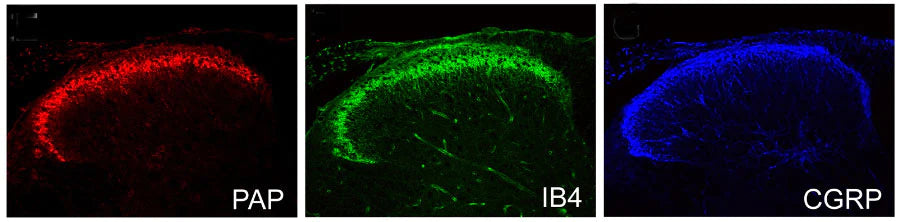
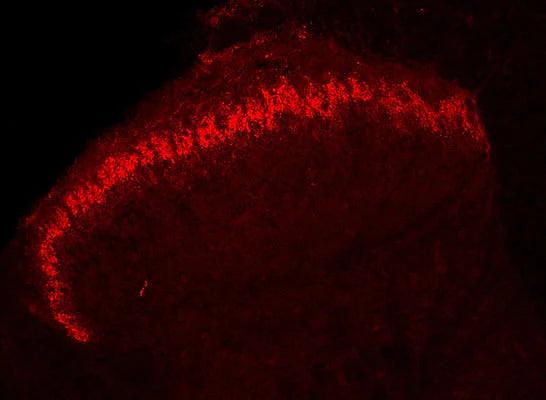
Recombinant mouse PAP protein was expressed in bacteria. Antibodies against this protein were prepared by injecting purified recombinant PAP into laying hens and purifying the IgY fraction from eggs collected from hyper-immunized hens. These antibodies have been validated with human, mouse and rat tissues.
Adult mouse DRG was fixed in 4% paraformaldehyde, cryostat-sectioned, and then stained for PAP immunoreactivity (1:500 dilution), showing immunoreactive material in primary sensory neurons. Photomicrograph by Dr. Mark Zilka, Univ. of North Carolina.
Mouse Prostatic Acid Phosphatase (PAP) is a 43,698 dalton protein (381 amino acids; NCBI accession number AAF23171) associated with prostatic cancer cells, as well as primary afferent sensory neurons involved in the pain pathway. This protein is an enzyme that dephosphorylates adenosine monophosphate (AMP) in the dorsal horn gray matter of the spinal cord, generating free adenosine. Injections of PAP into the dorsal horn of experimental mice has been shown to decrease pain perception by acting in an antinociceptive, antihyperalgesic, and antiallodynic fashion.
Mixture of IgY fraction and affinity-purified antibodies
10 mg/mL
Polyclonal
IgY
IHC, WB
Chicken
ACPP
45 kDa
Recombinant mouse PAP expressed in Escherichia coli
Human, Mouse, Rat
AB_2313557
Store at -20°C in the dark. Under these conditions, the antibodies should have a shelf life of at least twelve months, provided they remain sterile.
Liquid
Chickens were immunized with recombinant mouse Prostatic Acid Phosphatase protein. After repeated injections, immune eggs were collected from laying hens, from which IgY antibody were prepared ("anti-PAP IgY fraction"). Some of this antibody was further purified using an agarose matrix to which the PAP protein was covalently attached ("Affinity-purified anti-PAP"). The final preparation in the accompanying vial contains 10 mg/mL of the "anti-PAP IgY fraction" supplemented with 20 µg/mL of the "affinity-purified anti-PAP" plus 50% (v/v) glycerol (to prevent freezing at –20˚C). Finally, this antibody preparation was filter-sterilized (0.45 mm) and 200 ul aliquots prepared.
Sodium phosphate (10 mM, pH 7.2) buffered isotonic saline (0.9%, w/v), glycerol (50%, v/v), with sodium azide (0.02%,w/v) as an anti-microbial agent.
WB: 1:1000-1:2000
IHC: 1:500-1:1000
Antibodies were analyzed using immunohistochemistry with tissue sections through a 10%-formalin fixed adult mouse. Sections were examined for PAPpositive dorsal root ganglion sensory neurons. Secondary antibodies (fluorescein-labeled goat anti-chicken IgY, Aves Cat. #F-1004) were used at a concentration of 1:500.
These antibodies are to be used as research laboratory reagents and are not for use as diagnostic or therapeutic reagents in humans.
Lin, C.L., et al. 2018. Treatment with methyl-b-cyclodextrin prevents mechanical allodynia in resiniferatoxin neuropathy in a mouse model. Biology Open, bio039511.
Kan, H.W., et al. 2018. Downregulation of adenosine and adenosine A1 receptor contributes to neuropathic pain in resiniferatoxin neuropathy. Pain, 1580-1591.
Taylor-Blake, B., et al. 2010. Prostatic acid phosphatase is expressed in peptidergic and nonpeptidergic nociceptive neurons of mice and rats. PLoS One, e8674.
Nishida, K., et al. 2018. ATP metabolizing enzymes ENPP1, 2 and 3 are localized in sensory neurons of rat dorsal root ganglion. The European Journal of Histochemistry, 2877.
Taylor-Blake, B., et al. 2010. Prostatic acid phosphatase is expressed in peptidergic and nonpeptidergic nociceptive neurons of mice and rats. PLoS One, e8674.
Bulk Order Anti-Prostatic Acid Phosphatase Antibody
Related Products
Recently Viewed
We stand by what we sell.
We are proud of every product that leaves our lab.
Support from the source
No one knows our products like us, and we want you to succeed.